Top AI Tools Every TPM Needs in 2026: The "STACK" Framework for Maximum Productivity

This post breaks down the STACK framework, showcasing the top AI productivity tools and workflows Technical Program Managers can use to eliminate administrative overhead, track cross-repository dependencies, and scale program impact in FAANG interviews.

How Technical Program Managers Can Leverage AI Tools to Double Their Output

You’re managing three critical enterprise programs, coordinating across four engineering squads, and trying to align a cross-functional launch with marketing and legal. It’s 4:30 PM on a Thursday. You have 12 unread Slack threads demanding updates, a half-written Technical Design Document (TDD), and an executive status report due by 9:00 AM tomorrow.

Then, your interviewer asks: "What specific AI tools and workflows do you use in your daily operations to drive engineering efficiency and scale your program output?"

This is where unprepared candidates stumble.

They drop vague buzzwords: "I use ChatGPT for writing emails and Notion AI for taking notes."

Stop listing generic AI chatbots. Mentioning basic text tools reveals a surface-level understanding of modern engineering operations. FAANG hiring panels expect Technical Program Managers (TPMs) to act as technical systems integrators. They want to see that you leverage specialized AI tools across the entire program lifecycle—from code-level PR analysis and automated dependency mapping to dynamic risk modeling and executive reporting.

To prove technical leadership and operational mastery, you need a structured workflow: the STACK method.

The Core Framework: The "STACK" Method

Elite TPMs do not just prompt AI; they build an integrated operational stack that automates low-leverage admin tasks and surfaces high-signal program risks.

         [ Multi-Team Technical Program Execution ]
                             │
                             ▼
      ┌─────────────────────────────────────────────┐
      │     S-PEC & DOCUMENTATION GENERATION        │
      │  * Tools: Claude 3.5 Sonnet, GitHub Copilot │
      └──────────────────────┬──────────────────────┘
                             │
                             ▼
      ┌─────────────────────────────────────────────┐
      │     T-RIAGE & BACKLOG INTELLIGENCE          │
      │  * Tools: Linear Asks, Jira AI, Enterprise   │
      └──────────────────────┬──────────────────────┘
                             │
                             ▼
      ┌─────────────────────────────────────────────┐
      │     A-UTOMATED MEETING & DECISION EXTRACTION│
      │  * Tools: Otter.ai, Fathom, Granola         │
      └──────────────────────┬──────────────────────┘
                             │
                             ▼
      ┌─────────────────────────────────────────────┐
      │     C-ODE DEPENDENCY & RISK ANALYSIS        │
      │  * Tools: CodeSee, Bito, Sourcegraph Cody   │
      └──────────────────────┬──────────────────────┘
                             │
                             ▼
      ┌─────────────────────────────────────────────┐
      │     K-PI TRACKING & EXECUTIVE REPORTING     │
      │  * Tools: Gamma, ChatGPT Enterprise, Perplexity
      └──────────────────────┬──────────────────────┘
                             │
                             ▼
         [ Accelerated Delivery & High Impact ]

1. S-pec & Documentation Generation

Automate boilerplate technical documentation and API architecture drafts.

  • The Tools: Claude 3.5 Sonnet, GitHub Copilot Workspace, Notion AI.
  • The Strategy: Writing PRDs, technical charters, and architecture review checklists from scratch wastes valuable hours. Feed raw product requirements, API endpoints, and system constraints into specialized LLMs to generate structured initial drafts, edge-case matrices, and security compliance checklists.
  • Interview Script: "To accelerate planning, I use Claude 3.5 Sonnet to draft technical specs and edge-case matrices directly from raw system architecture logs. By generating a 70% complete technical design doc in minutes, I save our engineering leads 8 to 10 hours of drafting time per project cycle, shifting our focus immediately to technical review."

2. T-riage & Backlog Intelligence

Transform chaotic customer support tickets and unstructured feedback into prioritized epics.

  • The Tools: Linear Asks, Jira AI, DevRev.
  • The Strategy: Instead of spending hours manually reading bug reports and assigning priority tags, leverage AI triage engines to cluster incoming tickets by root-cause components, parse stack traces, and auto-assign initial severity scores.
  • Interview Script: "I integrate Jira AI and Linear Asks into our triage pipeline. Incoming customer escalations and system error logs are automatically clustered into functional component buckets, tagged with initial severity, and mapped to active epics. This cut our bug triage time by 65% and eliminated ticket duplication."

3. A-utomated Meeting & Decision Extraction

Eliminate manual note-taking during complex technical architecture reviews.

  • The Tools: Fathom, Granola, Otter.ai.
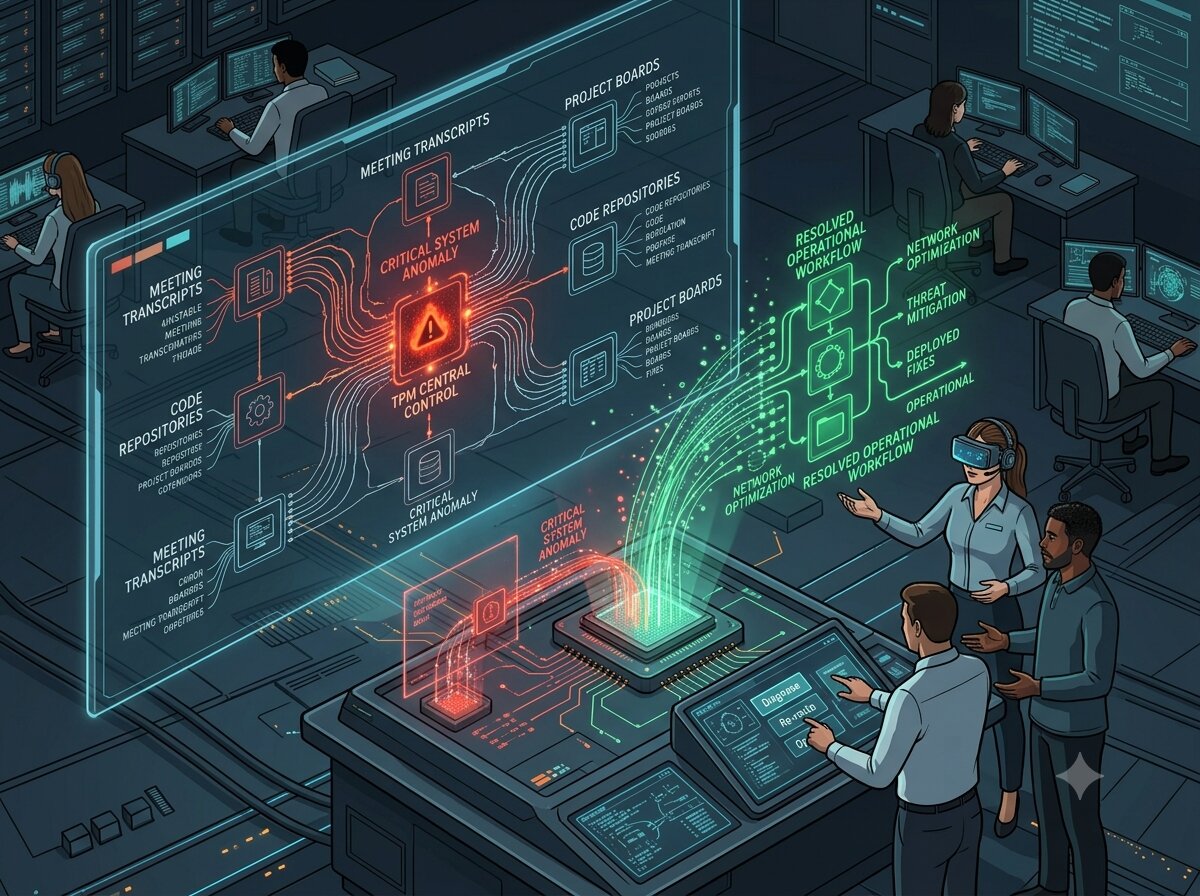
  • The Strategy: TPMs lose context when forced to manually record notes during intense technical debates. Deploy enterprise meeting intelligence tools to transcribe calls, parse architecture trade-offs, and automatically extract assigned action items into Slack or Jira.
  • Interview Script: "During cross-functional technical syncs, I use Granola to transcribe and parse technical discussions. Immediately after the call, the AI formats open technical risks, architectural decisions, and owned action items directly into our team Slack channel for immediate verification."

4. C-ode Dependency & Risk Analysis

Identify hidden cross-repository blockers before they impact release timelines.

  • The Tools: CodeSee, Bito, Sourcegraph Cody.
  • The Strategy: Traditional risk tracking relies on manual developer updates. Use code intelligence tools to analyze cross-repository pull requests, track API contract changes, and map inter-service dependencies in real time.
  • Interview Script: "Instead of relying on static spreadsheets, I leverage Sourcegraph Cody and CodeSee to analyze pull request velocity across dependent microservices. If an upstream API contract update lags behind our downstream integration milestone, the tool alerts me early so I can step in to de-risk the schedule."

5. K-PI Tracking & Executive Reporting

Tailor master program health data for different organizational audiences instantly.

  • The Tools: Gamma, Perplexity Enterprise, ChatGPT Enterprise.
  • The Strategy: Translating a single program update into tailored formats for engineers, directors, and executives can take half a day. Use generative presentation and reporting tools to synthesize technical metrics into high-level executive dashboards.
  • Interview Script: "I maintain a single master data layer for program health. Using custom prompt workflows in ChatGPT Enterprise, I instantly transform technical burn-down data into three formats: a detailed PR tracker for engineering leads, a milestone summary for product directors, and an ROI bullet list for executive sponsors."

The Comparison: Bad vs. Good

Bad Answer (Vague & Generic)Good Answer (STACK Framework)"I use ChatGPT to write my status emails and Notion AI to organize my personal task list every week.""I deploy the STACK framework: using Claude for drafting technical specs, Jira AI for automated ticket triage, Granola for meeting extraction, and Sourcegraph Cody to map cross-repository PR dependencies.""AI tools are okay, but I prefer to do everything manually using Excel and Jira to make sure nothing breaks.""Manual tracking creates operational bottlenecks. I automate low-signal data collection using AI, allowing me to focus my bandwidth on technical trade-offs and cross-functional alignment."

Scale Your TPM Career with Kracd

Mastering AI productivity tools is only one part of the senior TPM role. In FAANG-level interviews, you will be evaluated on your ability to handle complex system design trade-offs, drive cross-functional consensus, and manage multi-team technical delivery under tight constraints.

Take your preparation to the next level with battle-tested frameworks:

  • Dominate system design, technical execution, and program leadership loops with the TPM Prep Kit.
  • Master product strategy, cross-functional alignment, and metric frameworks with the PM Prep Guide.

FAQs

Q: How do you handle security and privacy concerns when using AI tools for internal program data?

A: Always enforce strict data governance by using enterprise-grade instances (e.g., ChatGPT Enterprise, Claude for Work) with Zero Data Retention (ZDR) agreements and disabled model training options. Never input raw customer PII, unannounced IP secrets, or production credentials into public AI models.

Q: Will AI tools make the role of a Technical Program Manager obsolete?

A: No. AI eliminates administrative overhead, meeting transcripts, and manual status tracking, but it cannot replace human technical judgment, negotiation, cross-functional conflict resolution, or strategic program alignment. TPMs who master AI tools will simply replace those who do not.

Q: What is the single most impactful AI workflow a TPM can implement today?

A: Automated meeting extraction and decision logging. Capturing technical decisions, open risks, and action items automatically from architecture calls saves 5+ hours a week and ensures total alignment across engineering leads.
Read more blogs

The AI-Powered TPM: How Technical Program Managers Can Leverage AI Tools to Double Operational Efficiency
How to Answer "Tell Me About a Time You Failed": The RESCUE Framework for PMs and TPMs
Top AI Tools Every TPM Needs in 2026: The "STACK" Framework for Maximum Productivity
Tech layoffs hit 205,832 in 2026 while AI roles surge 237%—learn the IRREPLACEABLE-SIGNAL framework TPMs use to stay hired
Tech Layoffs 2026: The IRREPLACEABLE-SIGNAL Framework TPMs Use to Survive AI Automation
How to Design an Enterprise AI Cost & Latency Gateway (PM/TPM Guide)

Designing Real-Time Multi-Modal AI Systems: The "STREAM" Framework
Side-by-side comparison showing 2023 supervised-ML vocabulary getting screened out versus 2026 autonomous-agent fluency
AI PM Interview 2026: The AGENT-PROOF Framework for Autonomous-Systems Fluency
How to Scale Real-Time GenAI Agents: The "AGENT-SCALE" Framework
How to Design an Enterprise LLM Evaluation & Guardrails Platform: The "SHIELD" Framework
How to Design an Enterprise RAG Platform: The "RAG-FLOW" Framework
How to Diagnose & Fix a Dropping Metric: The "DRIFT" Framework
How to Architect Autonomous Enterprise AI Agents: The "AGENT-FLOW" Framework
How to Architect Multimodal AI Platforms: The "MULTI-MODAL" Framework
How to Build Enterprise AI Safety, Guardrails & Governance: The "GUARD-RAIL" Framework
How to Architect Enterprise LLM Fine-Tuning & Distillation: The "ADAPT-MODEL" Framework
How to Architect High-Throughput RAG Systems: The "VECTOR-FLOW" Framework
How to Architect Multi-Agent AI Systems: The "AGENT-FLOW" Framework
How to Master LLM Evaluation & Telemetry at Scale: The "EVAL-METRICS" Framework
How to Mitigate LLM Hallucinations in High-Stakes Applications: The "FAITHFUL-AI" Framework
How to Evaluate RAG vs. Fine-Tuning for Enterprise AI: The "KNOWLEDGE-EVAL" Trade-Off Framework
How to Design an Enterprise AI Agent Architecture: The "AGENT-SCALE" Orchestration Framework
How to Deploy and Validate a New AI Model: The "SAFE-ROLLOUT" Testing Framework
How to Manage a High-Stakes Project Slip: The "SCOPE-ALIGNED" Mitigation Framework
How to Handle an AI Model Regression: The "MODEL-VALIDATE" Diagnostic Framework
Tell Me About a Time You Failed: The "BOUNCE-BACK" Behavioral Framework
How to Handle a Dropping Metric: The "ROOT-CAUSE" Analytical Framework
How to Architect a Globally Scalable Notification Engine: The "FAN-OUT" Priority Delivery Framework
How to Architect an Enterprise-Grade Vector Search Engine: The "VECTOR-SHARD" Data Framework
How to Architect a High-Concurrency API Gateway: The "GATE-KEEPER" Edge Routing Framework
How to Architect a Distributed Telemetry & Logging System: The "TRACE-STREAM" Observability Framework
How to Architect an Enterprise LLM Deployment: The "RAG-OPS" Production Scale Framework
How to Handle a Dropping Metric: The "METRIC-TRIAGE" System Design Framework
How to Architect a Globally Scalable Financial Ledger System: The PM & TPM "LEDGER-BALANCE" Framework
How to Architect a Globally Scalable Real-Time Ad Bidding & Ad Tech Exchange: The PM & TPM "RTB-AUCTION" Framework
How to Architect a Globally Scalable Real-Time Recommendation Engine: The PM & TPM "RECO-MATRIX" Framework
How to Architect an Enterprise LLM Evaluation & Monitoring Pipeline: The PM & TPM "GUARD-RAIL" Framework
How to Design an Enterprise Agentic AI Workflow: The PM & TPM "ORCHESTRATE-AGENT" Framework
How to Architect an Enterprise Retrieval-Augmented Generation (RAG) Architecture: The PM & TPM "KNOWLEDGE-CORE" Framework
How to Architect a Globally Scalable Event-Driven Architecture: The PM & TPM "STREAM-FLOW" Framework
How to Manage Cache Invalidation and Consistency: The PM & TPM "CACHE-CLEAR" Framework
How to Manage Data Privacy and Cross-Border Transfers: The PM & TPM "DATA-BOUNDARY" Framework
How to Design an Enterprise AI Orchestration Layer: The PM & TPM "GATEWAY-AI" Framework
How to Architect a High-Throughput API Gateway: The PM & TPM "GATE-KEEPER" Framework
How to Diagnose and Fix a Dropping Metric: The PM & TPM "METRIC-TRIAGE" Framework
How to Optimize Cloud Infrastructure Unit Economics: The PM & TPM "FIN-SCALE" Framework
How to Manage Technical Debt and Refactoring Backlogs: The PM & TPM "PAY-DOWN" Framework
How to Coordinate Multi-Region Cloud Failovers: The PM & TPM "ZONE-DEFENSE" Framework
How to Orchestrate Massive API Deprecations Without Breaking Ecosystems: The PM & TPM "DECOUPLE-FLOW" Framework
How to Lead Large-Scale Corporate AI Transformations: The PM & TPM "CORE-INTEGRATE" Framework
How to Scale Infrastructure Upgrades Without Downtime: The PM & TPM "LIVE-MIGRATE" Framework
How to Architect an AI-Powered Quality Assurance & Release Engine: The PM & TPM "BUG-SHIELD" Framework
How to Formulate the Ultimate "Product-to-Engineering" Spec Engine: The PM & TPM "TECH-TRANSLATE" Framework
How to Leverage AI for Cross-Functional Product Alignment: The PM & TPM "SYNCHRONIZE" Framework
How to Build a Complete AI-Powered Agile Workflow: The PM & TPM "CORE-VELOCITY" Framework
How to Automate High-Friction Dependency Mapping and Jira Tracking: The "AUTO-TRACK" TPM Workflow
How to Handle a Critical API Rate Limiting and Service Degradation Crisis: The "THROTTLE-GUARD" Resilience Framework
How to Handle a High-Scale Database Crash During Peak Traffic: The "FAILOVER-SHIELD" Recovery Framework
How to Handle an Algorithmic Model Bias Crisis: The "ETHICAL-AUDIT" ML Governance Framework
How to Handle a Major Cloud Migration Failure: The "CLOUD-SAFETY" Rollback Framework
How to Handle a Major Technical Program Delay: The "RE-BASELINE" Schedule Recovery Framework
How to Handle a Database Sharding Migration: The "DATA-BALANCE" Scale Framework
How to Handle a Critical Third-Party API Sunset: The "DEPENDENCY-BUFFER" Integration Framework
How to Handle a Pricing Tier Change: The "PRICING-SHIELD" Revenue Framework
next How to Handle a Post-Launch Crisis: The "ROLL-BACK" Incident Management Framework
How to Handle a Critical API Migration: The "DECOUPLE-SAFE" Architecture Framework
How to Handle a Major System Outage: The "TRIAGE-SCALE" Technical Execution Framework
How to Resolve Cross-Functional Gridlock: The "BRIDGE-ALIGN" Trade-off Framework
How to Handle a Dropping Metric: The "DIG-DEEP" Root Cause Framework
How to Master the Behavioral Interview: The "STAR-GROWTH" Method
How to Lead a Product Launch: The "GTM-VELOCITY" Framework
How to Design a Product for the Next Billion Users: The "ADAPT-LIGHT" Framework
How to Negotiate Your Senior Tech Offer: The "VALUE-ANCHOR" Method
How to Master the Behavioral Interview: The "STAR-GROWTH" Method
How to Lead a Product Launch: The "GTM-VELOCITY" Framework
How to Design a Product from Scratch: The "EMPATHY-SCALE" Framework
How to Prioritize Features: The "RICE-VALUE" Framework
How to Design for the Next Billion Users: The "ADAPT-LIGHT" Framework
How to Build an AI-First Feature: The "RAG-EVAL" Framework
Move from a Monolith to Microservices: The "STRANGLE-SHIELD" Framework
How Do You Decide When to Build vs. Buy?: The "MOAT-LEVER" Framework
How Do You Handle a Conflict Between Engineering and Design?: The "TRIANGLE-TRADE" Framework
How Do You Manage a Delayed Project?: The "REALIGN-RECOVER" Framework
How Do You Design an API?: The "CONTRACT-FIRST" Framework
How Do You Prioritise a Roadmap?: The "ROI-ALIGN" Framework
How to Answer "Tell Me About a Time You Failed": The "PIVOT-OWN" Framework
How to Handle a Dropping Metric: The "SEGMENT-DRILL" Framework
The "Incentive-Alignment" Framework: Building in Web3
The "Value-Tradeoff" Framework: Mastering the Art of "No"
The "Cycle-Velocity" Framework: Building Viral Loops
The "Agentic-Utility" Framework: Building AI-First Features
The "Proxy-Experience" Framework: Mastering the Career Pivot
The "Throughput-Engine" Framework: Elite Productivity
The "Pause-Pivot" Framework: Leading the Room
The "Curated-Authority" Framework: Building Your Tech Brand
The "Throughput-First" Framework: Managing the Sprint
The "Segment-Drill" Framework: Winning with Data
The "Identity-Loop" Framework: Building the Community Moat
The "TTV" Framework: Mastering the First 5 Minutes
The "Red-Team" Framework: Building Ethical AI
The "Extensibility-First" Framework: Building the Ecosystem

Transform Your Career with Our Complete Learning Solutions

Discover our diverse offerings, including expert-led courses, free training sessions, and personalized consultation services designed to help you master project management and advance your career with confidence.

FREE Training

Crack your next TPM Interview

From unravelling the intricacies of TPM/PM interview structures to mastering system design to discover the keys to navigating cross-functional collaboration, decoding top interview questions, and fine-tuning your resume and LinkedIn profile, including negotiation frameworks, networking strategies, and much more!

Register Now

Trusted by over 9,600 students

Course

30-Day TPM Masterclass

Expect early technical assessments, followed by a focus on strategic thinking, leadership capabilities, and a thorough evaluation of program management proficiency. From engaging self-guided exercises to comprehensive guides, frameworks, and sample answers, our TPM interview preparation covers it all, including practice lessons, updated content, and mock interviews.

Learn More

Trusted by over 9,600 students

Interview Prep Kit

Ultimate TPM Interview Prep Kit

Master TPM interview skills with this comprehensive guide covering system design, program management, and cross-functional collaboration.

Includes real-world scenarios, sample questions, and expert tips for success.

Learn More

Trusted by over 9,600 students

Interview Prep Guide

Complete PM Interview Guide

Master product design, strategy, and leadership with this all-in-one guide for Product Management interviews.

Gain confidence with actionable advice, real-world examples, and tailored mock questions to secure your next PM role.

Learn More

Trusted by over 9,600 students

Consulting

1-on-1 Interview Prep

1-on-1 Interview PreparationGet personalized guidance to ace your next interview with confidence. Our 1-on-1 interview preparation sessions focus on your unique strengths and areas for improvement. From tailored practice questions and feedback to mastering behavioral and technical responses, we ensure you're fully prepared to impress and secure your dream role.

Book a call

Trusted by over 9,600 students

Free Training

Unlock  Free Training

Get access to free training that reveals "How To crack your next TPM INTERVIEW In Just 30 Days!"

Gain exclusive access to expert-led training sessions designed to equip you with the skills, strategies, and confidence to excel in Technical Program Management.

Enroll now

Trusted by over 9,600 students