The Interview Trap: The "Work-Harder" Illusion
The interviewer throws you into a classic high-pressure project management crisis: "You are leading a massive, cross-functional mobile app rewrite that is legally mandated to launch in 90 days. During your weekly sync, the core backend engineering lead drops a bomb: due to unforeseen technical debt, they are running four weeks behind schedule. Your launch date cannot move. What do you do?" Most candidates panic and fall into the "hero manager" trap: "I'd set up daily status syncs, tell the team to work overtime on weekends, and push harder to get the code shipped on time." Stop. "Pushing harder" isn't a strategy; it's a fast track to team burnout, low code quality, and an unstable production release. In a FAANG execution or program management loop, they are testing your Scope-Triaging Methodology, Stakeholder Management, and Data-Driven Schedule Re-Baselining.
The Core Framework: The "RE-BASELINE" Method
When a critical milestone slips, a senior program leader strips emotion from the data. You must objectively audit your constraints, aggressively pare down your scope, and establish a realistic, de-risked roadmap forward.
1. R-oot Cause & Critical Path Analysis
Before changing a single ticket, calculate the exact upstream and downstream impact of the delay.
- The Strategy: Trace the blocker through your Gantt chart or dependency graph to find out if it directly impacts your final launch milestone.
- The Soundbite: "I will start by analyzing our critical path. I need to dig past the high-level panic and see if this four-week backend delay sits directly on the critical path to launch. If it does, every subsequent milestone—like QA integration testing, security compliance reviews, and beta rollouts—is delayed by exactly four weeks. We must pinpoint the exact technical blocker to see if we can unblock the path."
2. E-stimate True Velocity and Capacity
Recalculate your team's real-world delivery metrics, not their idealistic sprint goals.
- The Strategy: Use historical burn-down charts and current velocity metrics to forecast a realistic completion timeline based on the remaining work.
- The Soundbite: "I'll audit our engineering velocity over the last three sprints. We cannot plan the remaining 90 days using best-case scenarios. I will sit with the engineering manager to recalculate our true capacity, factoring in expected PTO, system stabilization overhead, and the historical bug-swapping rate to build a predictable, data-backed timeline."
3. B-undled Scope Triaging (MoSCoW Method)
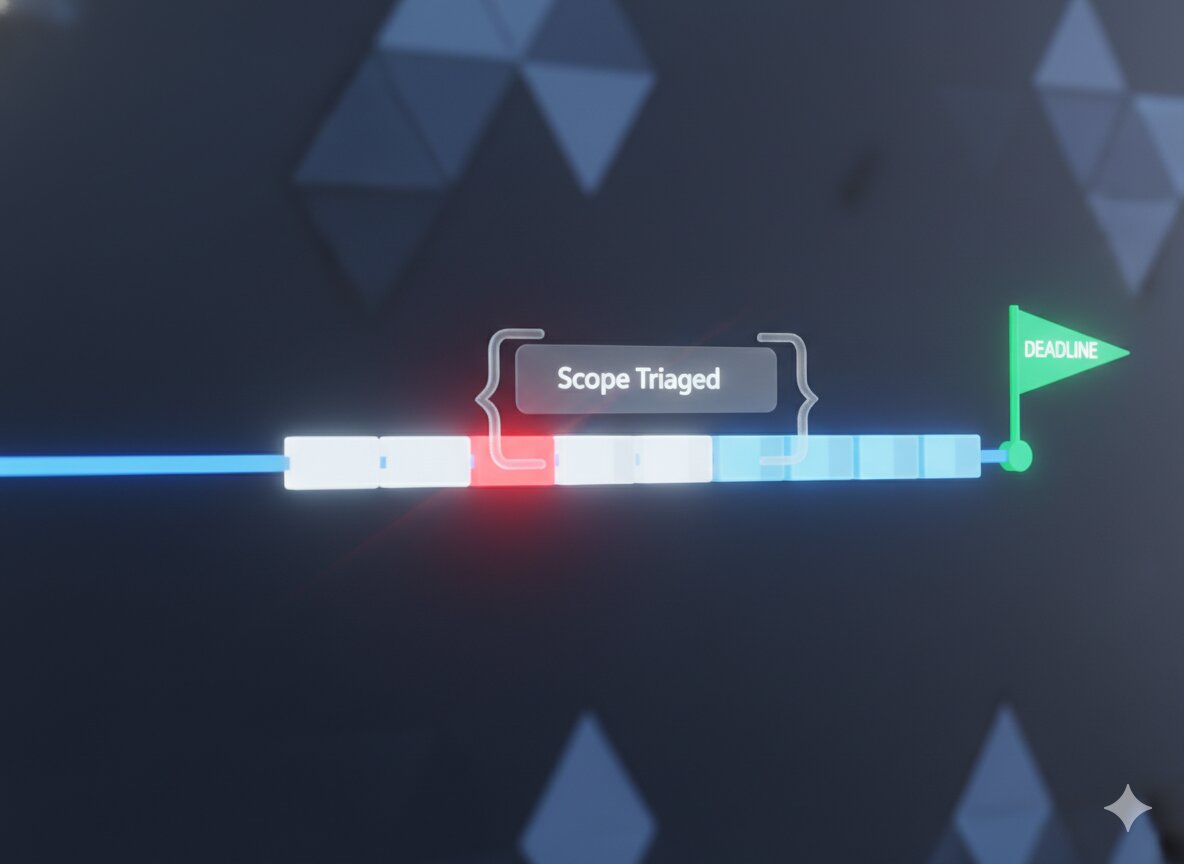
Protect your hard deadline by aggressively cutting out non-essential product features.
- The Strategy: Force product management and engineering to sort the remaining features into Must-haves, Should-haves, Could-haves, and Won't-haves (MoSCoW).
- The Soundbite: "Since our 90-day launch date is set in stone, our only flexible variable is scope. I will pull the Product and Engineering leads into an emergency scope-triaging room. We will run a ruthless MoSCoW audit on our remaining backlog. Every feature that isn't absolutely critical to our core user flow or legal compliance will be cut or pushed to a 'Phase 2' post-launch release."
4. A-synchronous Team Parallelization (Unblocking QA)
Modify your engineering workflows so downstream teams aren't left waiting around idly.
- The Strategy: Use API mocking, data stubbing, and feature flags to let frontend and QA teams build and test features before the backend is fully completed.
- The Soundbite: "To minimize the backend bottleneck, we must unblock our frontend and QA teams. I will have the backend team prioritize defining the API contract schemas. Once those contracts are locked, we will mock the backend data payloads. This lets the frontend mobile engineers and QA automation teams write and test their code against synthetic endpoints concurrently, saving us weeks of sequential wait time."
5. S-takeholder Realignment & Flash Communications
Manage expectations early across the organization to preserve internal trust and prevent executive surprises.
- The Strategy: Issue a highly structured, objective status update to cross-functional partners detailing the impact, the trade-offs, and the recovery plan.
- The Soundbite: "I will send a transparent program update to leadership. I won't just raise an alarm; I’ll present a structured trade-off matrix. I’ll explicitly outline: 'The backend delay has introduced a four-week critical path risk. To protect our 90-day launch target, we are de-scoping these three specific non-core features and parallelizing QA using API mocking. This stabilizes our launch probability at 95%.' This controls the narrative and aligns expectations immediately."
6. E-levate Critical Engineering Resources
Strategically shift human capital to unblock the bottleneck if the project permits it.
- The Strategy: Move senior engineers from non-critical, parallel workstreams to focus entirely on the core backend architecture blocking the pipeline.
- The Soundbite: "I will review resource allocation across our broader program portfolio. If Brook's Law warns us that dropping random new engineers into a late project makes it later, we can still selectively pivot a senior infrastructure engineer who already understands our codebase to unblock the backend team's specific architectural hurdles, accelerating their delivery."
7. L-ive Tracking and Micro-Milestones
Break down the remaining timeline into smaller, high-visibility checkpoints to catch any future drift instantly.
- The Strategy: Move away from broad bi-weekly sprint reviews and implement tight 48-hour micro-milestones to monitor recovery progress in real time.
- The Soundbite: "During this high-risk recovery window, we'll implement tight 48-hour micro-milestones. We cannot wait until the end of a two-week sprint to find out if we're slipping further. We will track granular technical indicators—like daily PR merge rates and endpoint completeness—so we can spot and correct any schedule drift within hours."
8. I-ntegration Testing Buffer Safeguards
Never shorten your quality assurance and testing windows to make up for lost development time.
- The Strategy: Keep a dedicated regression and stress-testing window open before the launch to protect product quality.
- The Soundbite: "I will fiercely protect our core integration testing buffer. Rushing code straight into production without robust end-to-end regression testing guarantees a broken launch. By aggressively cutting scope early, we ensure our QA teams still have their dedicated time to run security and load testing, protecting our brand and user experience."
9. N-ew Program Baseline Finalization
Lock in the updated, triaged schedule as your new source of truth and move forward.
- The Strategy: Formalize the updated scope and milestones in your tracking tools so the entire organization works off the same plan.
- The Soundbite: "Once scope trade-offs are approved and micro-milestones are locked, I will officially update our program charter. We lock in this new baseline, update our Jira or Asana tracking dashboards, and align all engineering, marketing, and operations teams around this singular, de-risked timeline."
10. E-xecute Blameless Retrospective
Post-launch, run a structured review to fix the root estimation flaws that caused the delay in the first place.
- The Strategy: Lead a post-mortem to analyze why the technical debt was missed during the initial scoping phase and optimize future planning.
- The Soundbite: "After we successfully hit our 90-day compliance launch, I will run a blameless program retrospective. We will figure out why this backend technical debt wasn't discovered during our initial scoping phase. We'll turn those lessons into permanent checklist updates for our technical design reviews, ensuring our future project roadmaps are built with a more accurate structural lens."
The Comparison: Bad vs. Good
- Bad Answer: "I would schedule daily syncs with the developers, ask them to work late nights to make up for the four lost weeks, tell product that we can't change any features, and cross my fingers that we hit the 90-day deadline." (Reactive, completely ignores resource capacity, guarantees burnout and failure).
- Good Answer: "I will lead a data-driven schedule recovery by running a critical path analysis, ruthlessly triaging non-essential scope using the MoSCoW method, unblocking frontend and QA teams via API mocking, and tracking progress through tight micro-milestones while protecting our core testing buffers." (Operationally disciplined, highly structural, realistic leadership).
Master Technical Delivery and Program Execution Rounds
When a project drops behind schedule, a leader's true execution capability is revealed. Showing an interview panel that you can calmly manage executive pressure, run a data-backed scope-triaging loop, and re-engineer engineering workflows to save weeks of time proves you possess elite organizational maturity. The RE-BASELINE framework teaches you how to guide complex technical programs through volatile disruptions cleanly and predictably.
The Kracd Prep Kits provide comprehensive program management toolsets, including resource-leveling blueprints, critical path optimization guides, and stakeholder communication templates.
- For PMs: Protect your core product metrics and cross-functional trust during schedule crises with the PM Prep Guide.
- For TPMs: Master massive technical dependencies, multi-team critical paths, and execution scale under tight deadlines with the TPM Prep Kit.
FAQs
Q: What if the Product Manager refuses to let any features be cut from the launch?A: Bring data to the discussion. Frame it as a mathematical certainty, not an opinion: "Based on our historical velocity, the engineering team can deliver exactly 60 story points in the remaining time. The current backlog sits at 90 story points. We have a hard resource deficit. If we do not choose which 30 points to cut now, the system will choose for us at launch by delivering an incomplete, broken, and un-tested mobile app."
Q: How do you keep team morale high when a project is behind schedule?A: Eliminate ambiguity and show a clear path forward. Morale drops when engineers feel trapped under unrealistic deadlines with no relief in sight. By aggressively cutting non-essential scope and breaking the remaining work into clear, manageable micro-milestones, you show the team a realistic path to success, instantly lowering pressure and restoring focus.
Q: Should you ask leadership for a deadline extension as a first step?A: No, treat an extension as an absolute last resort. Executive leadership sets hard deadlines for major business reasons—such as marketing campaigns, contractual agreements, or legal regulations. Pushing for an extension before triaging scope or optimizing your engineering pipeline shows a lack of creative problem-solving and operational resourcefulness.






















.jpg)