Introduction
The VP of Engineering steps to the whiteboard during an AI System Architecture review: "We are scaling an enterprise-grade, autonomous software engineering agent. It needs to read pull requests, analyze codebase dependencies, plan multi-file refactors, write unit tests, and deploy code without human intervention unless an error occurs. How do you design an orchestration architecture—choosing between single-agent loops vs. multi-agent topologies—to manage context windows, handle tool execution failures, avoid infinite loops, and guarantee state persistence across long-running tasks?"
This is where candidates fall into the "Agentic Over-Engineering" trap.
They suggest complex, fragile setups: "We'll deploy eight autonomous agents that talk to each other in an open group chat," or "We'll let an LLM decide its own execution flow dynamically with zero constraints."
Stop designing unstructured, free-form multi-agent chat loops. Unbounded multi-agent environments suffer from exponential context window growth, cascading tool execution errors, infinite loops, and sky-high token costs. In elite FAANG AI Product Management and TPM architecture loops, panels evaluate your grasp of Deterministic Orchestration, Finite State Machines (FSMs), Message-Passing Protocols, Shared Memory Architectures, and Human-in-the-Loop (HITL) Safety Gates.
To pass this advanced GenAI orchestration and system design round, you need a battle-tested architectural framework: the AGENT-FLOW method.
The Core Framework: The "AGENT-FLOW" Method
Elite AI platform leaders don't let agents converse aimlessly. They enforce deterministic state machine boundaries around specialized model roles.
                      [ User Task / PR Refactor Request ]
                                       │
                                       ▼
       ┌────────────────────────────────────────────────────────────────┐
       │             A-RCHITECTURE & TOPOLOGY SELECTION                 │
       │  * Router / Hierarchical Supervisor + Specialized Workers       │
       └───────────────────────────────┬────────────────────────────────┘
                                       │
                                       ▼
       ┌────────────────────────────────────────────────────────────────┐
       │             G-UARDRAILED STATE & CONTEXT ISOLATION             │
       │  * Shared State Graph / Ephemeral Worker Context Windows        │
       └───────────────────────────────┬────────────────────────────────┘
                                       │
                                       ▼
       ┌────────────────────────────────────────────────────────────────┐
       │             E-XECUTION RECOVERY & ERROR LOOP LIMITS            │
       │  * Max-step counters, Tool Self-Correction, Circuit Breakers  │
       └───────────────────────────────┬────────────────────────────────┘
                                       │
                                       ▼
       ┌────────────────────────────────────────────────────────────────┐
       │             N-EGOTIATION & STRUCTURED MESSAGE SCHEMAS          │
       │  * JSON Schema outputs, Function Calling, Strict Handoffs       │
       └───────────────────────────────┬────────────────────────────────┘
                                       │
                                       ▼
       ┌────────────────────────────────────────────────────────────────┐
       │             T-RACKING, PERSISTENCE & HITL CHECKPOINTS          │
       │  * Checkpointing DB, Human-in-the-Loop approval gates          │
       └───────────────────────────────┬────────────────────────────────┘
                                       │
                                       ▼
                        [ Safe, Executed Task / Code PR ]
1. A-rchitecture & Topology Selection
Select the right communication structure based on task complexity.
- The Strategy: Avoid fully connected "group chats." Choose between:
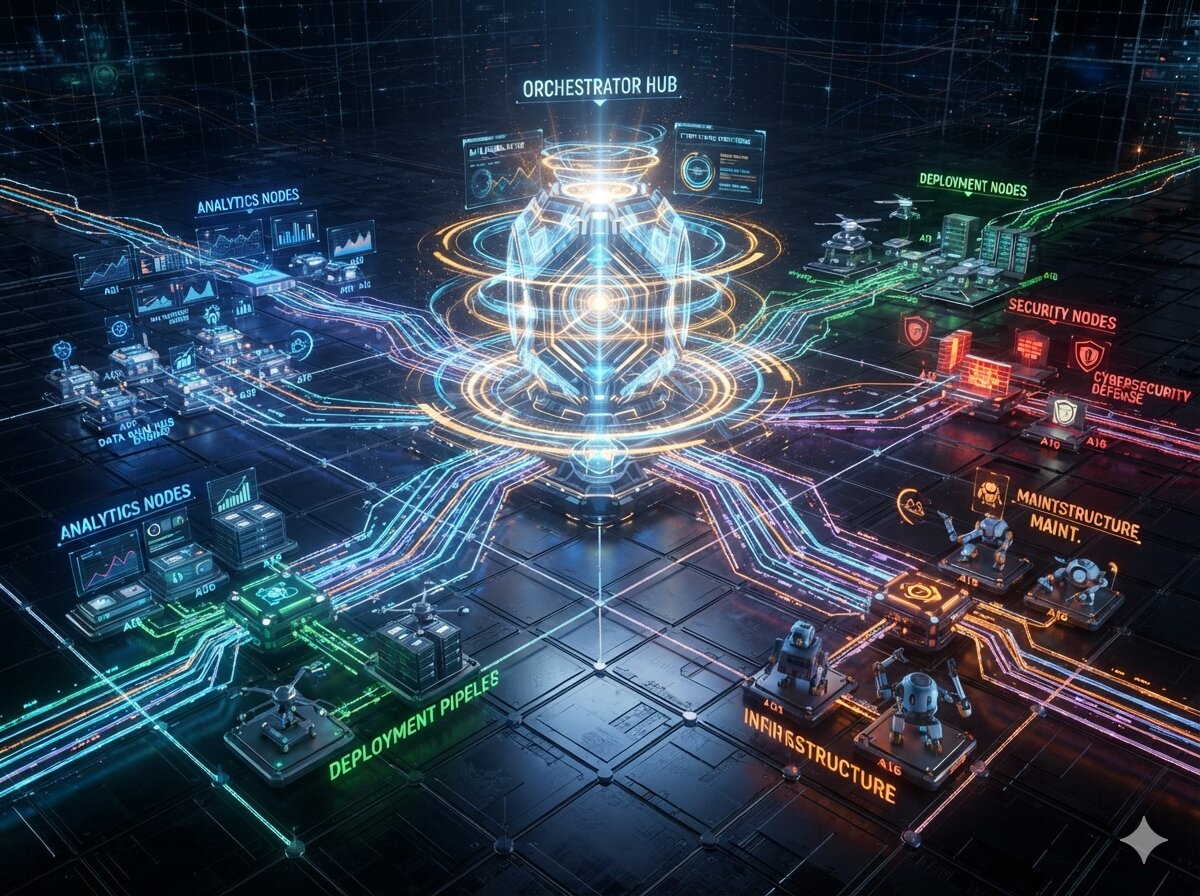
- Router / Orchestrator-Worker Pattern: A central supervisor breaks down the goal and routes discrete sub-tasks to specialized worker agents (e.g., Code Reviewer Agent, Test Runner Agent).
- Sequential Pipeline: Agent $A$ passes structured output directly to Agent $B$.
- Interview Script: "First, we select an Orchestrator-Worker topology built on a Directed Acyclic Graph (DAG) or Finite State Machine (FSM). Rather than allowing agents to chat freely, a central Supervisor Agent breaks down the PR into sub-tasks and delegates execution to specialized, narrow-scope worker agents."
2. G-uardrailed State & Context Isolation
Prevent context window rot by separating global state from worker memory.
- The Strategy: Implement a Shared Global State Graph (containing high-level goals, execution artifacts, and final outputs). Keep individual worker agent context windows ephemeral—workers receive only the state variables required for their specific tool action, then collapse their context upon execution.
- Interview Script: "To prevent context bloat and token cost inflation, we decouple global state from local execution. We store high-level task status in a centralized Shared State Graph. Workers operate on isolated, short-lived context windows that receive only the exact data required for their sub-task."
3. E-xecution Recovery & Error Loop Limits
Prevent runaway cost loops and handle tool execution failures gracefully.
- The Strategy: Set explicit execution limits:
- Max-Step Counters: Hard-cap loop iterations (e.g., $N \le 5$ tool retries).
- Reflection / Self-Correction Loops: If a tool call fails (e.g., unit test failure), feed the stack trace back to the worker once or twice to self-correct.
- Circuit Breakers: Tripped if the agent repeats the exact same failing tool call twice.
- Interview Script: "We build deterministic circuit breakers into our execution runtime. If the Test Runner Agent fails a unit test, it gets a maximum of two reflection loops to analyze the error stack trace and patch the code. If it exceeds five total steps without progress, the circuit breaker trips and halts execution."
4. N-egotiation & Structured Message Schemas
Enforce strict interface contracts for inter-agent communication.
- The Strategy: Never allow raw natural language handoffs between agents. Enforce Structured JSON Schemas and function calling contracts. When the Planner Agent yields control to the Coder Agent, it passes a validated JSON payload containing target file paths, specific function signatures, and acceptance criteria.
- Interview Script: "Inter-agent communication uses strict JSON Schemas enforced via structured outputs. When the Orchestrator assigns a task to a Worker, it passes a typed schema payload rather than natural language, eliminating misinterpretation across step transitions."
5. T-racking, Persistence & HITL Checkpoints
Ensure durability across long-running tasks and enforce human oversight.
- The Strategy: Store execution snapshots in a persistent database (e.g., PostgreSQL or Redis state store) at every state node. Insert explicit Human-in-the-Loop (HITL) approval nodes before high-impact or destructive actions (e.g., merging code to
mainor deploying to production). - Interview Script: "We persist the state graph to a database at every node transition, enabling time-travel debugging and pause-and-resume execution. Finally, we insert mandatory HITL checkpoints prior to destructive state changes, requiring explicit human approval before code is merged or deployed."
The Comparison: Bad vs. Good
Bad Answer (Unstructured Multi-Agent)Good Answer (AGENT-FLOW Framework)"We'll set up multiple autonomous agents using an open chat model so they can discuss the codebase, brainstorm solutions together, and fix bugs dynamically.""I will implement the AGENT-FLOW framework. I will structure the system as an Orchestrator-Worker DAG, isolate worker context windows, enforce JSON schema handoffs, set max-step circuit breakers, and require HITL checkpoints for production deployment.""If an agent gets stuck in a loop, we can just give it a higher temperature setting so it thinks of new creative ideas to solve the bug.""We handle loops deterministically. We enforce step limits ($N \le 5$), analyze tool call hashes to detect repetitive loops, and trip automated circuit breakers to escalate the issue to a human engineer."
The Pitch/Transition
Architecting reliable multi-agent systems requires moving beyond autonomous novelties toward disciplined state machine engineering, isolated context management, and strict safety boundaries. The AGENT-FLOW framework provides the blueprint needed to build durable, production-ready AI agent architectures.
In elite FAANG AI Product Management and TPM system design interviews, hiring panels look for leaders who can tame stochastic model behavior using deterministic systems engineering.
Prepare with production-validated AI frameworks, enterprise system design blueprints, and authoritative infrastructure vocabulary:
- Command your AI product strategy, execution metrics, and architecture rounds with the comprehensive PM Prep Guide.
- Dominate your system design, multi-agent infrastructure, and platform execution loops with the tactical TPM Prep Kit.
FAQs
Q: When should you choose a Single-Agent ReAct loop vs. a Multi-Agent architecture?
A: Use a Single-Agent ReAct loop when the task is linear, requires fewer than 5 sequential tool calls, and fits comfortably within a single context window (e.g., querying a database and formatting a summary). Choose a Multi-Agent architecture when tasks require distinct domain skill sets (e.g., writing vs. auditing vs. executing), parallel tool execution paths, or complex workflows that would overflow a single context window.
Q: How do you handle state persistence in long-running agent workflows?
A: Implement Event-Sourced State Checkpointing. After every agent action or tool execution, serialize the current state graph snapshot (inputs, outputs, execution logs, pending tasks) into a persistent database (like PostgreSQL or Redis). If a worker crashes or a API call times out, the system can resume from the exact last-known good node without re-running prior expensive tool calls.
Q: What is the best way to prevent agents from getting stuck in infinite tool-use loops?
A: Enforce a three-layer safeguard:
- Loop Hash Tracking: Compute a hash of every tool call name and argument payload. If identical hashes repeat consecutively, interrupt the loop.
- Deterministic Step Limits: Set a strict limit on maximum allowable iterations per sub-task.
- Fallback / Escalation Nodes: Route the execution state automatically to an error recovery node or human reviewer when limits are hit.











.jpg)