The Interview Trap: The "Panic and Pivot" Mistake
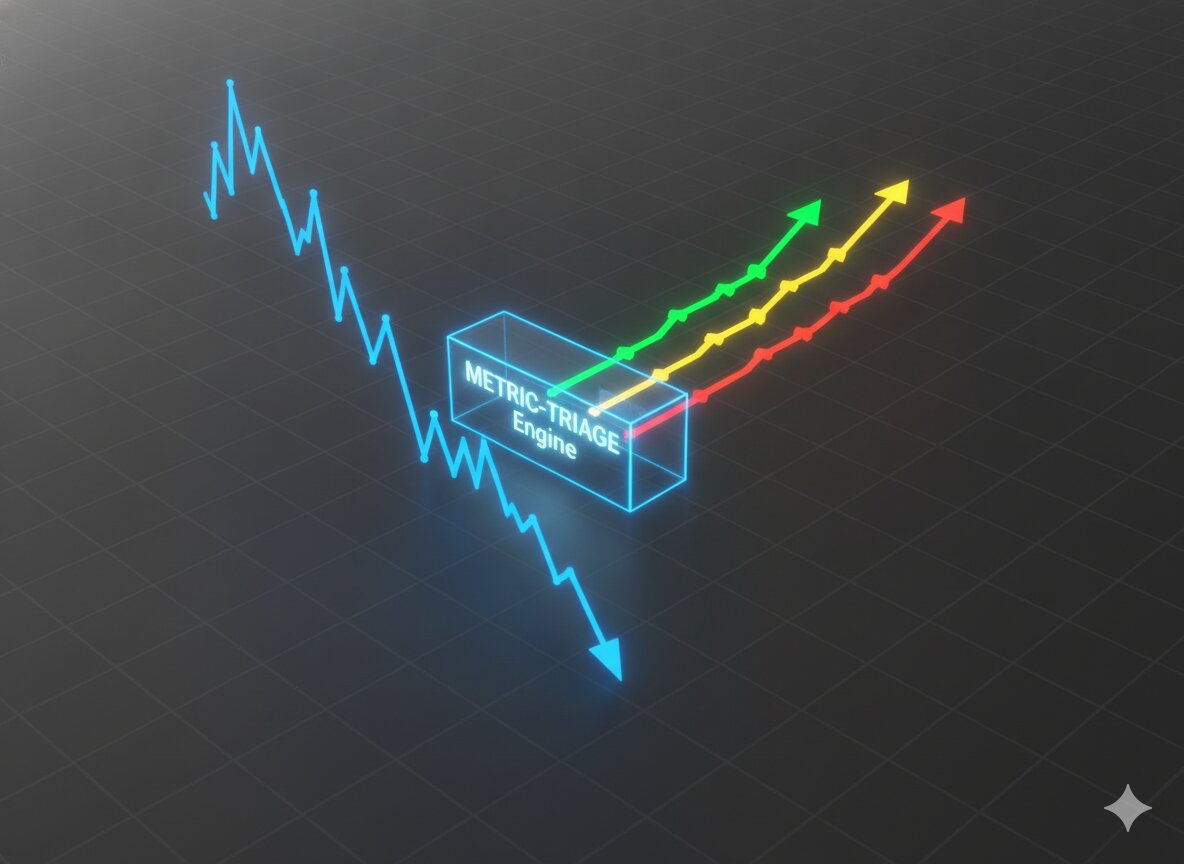
The interviewer looks at you and says: "Your core engagement metric just dropped by 15% overnight. What do you do?" Most candidates panic. They immediately jump to solutions: "I’d launch a marketing campaign," or "I’d add a new feature to bring them back." Stop. Jumping to solutions without a diagnosis is a red flag. It shows you lack analytical rigor. In a FAANG interview, they aren't looking for a "fix"—they are looking for your Investigative Process.
The Core Framework: The "DIG-DEEP" Method
To solve a metric drop, you must move from the widest possible lens to the most specific root cause.
1. D-efine and Validate
Is the drop even real?
- The Strategy: Check for data integrity issues before sounding the alarm.
- The Soundbite: "First, I would validate the data. Is this a logging error, a dashboard bug, or a broken data pipeline? I’d check with the Data Engineering team to ensure our 'source of truth' is actually accurate before investigating further."
2. I-solate the Segment
Is the drop happening everywhere, or in a specific pocket?
- The Strategy: Slice the data by dimensions (Geography, Device, Version, User Cohort).
- The Soundbite: "I’ll isolate the drop. Is it specific to Android vs. iOS? Is it happening only in the US market? If the drop is only on the latest app version on Android, I can narrow my search to a specific code deployment or a bug in that release."
3. G-auge Internal Changes
Did we do this to ourselves?
- The Strategy: Look at recent launches, experiments, or marketing shifts.
- The Soundbite: "I’d review our internal 'Change Log.' Did we recently ship a feature that cannibalized this metric? Are we running an A/B test that is negatively impacting the user experience? Often, the cause is a deliberate change that had unintended side effects."
4. D-etect External Factors
Is the world changing around us?
- The Strategy: Check for seasonality, competitors, or platform outages.
- The Soundbite: "I’d look externally. Is there a holiday affecting usage? Did a competitor launch a major campaign? Or is there a platform-level issue, like an ISP outage or a change in the App Store’s ranking algorithm?"
5. E-valuate the Funnel
Where exactly are users falling off?
- The Strategy: Map the user journey to find the friction point.
- The Soundbite: "I’ll look at the upstream and downstream metrics. If 'Daily Active Users' (DAU) is down, is it because 'New User Signups' dropped, or because 'Retention' of old users fell? Pinpointing the exact step in the funnel allows us to form a targeted hypothesis."
6. P-ropose and Prioritize
Only now do you suggest a fix.
- The Strategy: Formulate a hypothesis and test it.
- The Soundbite: "Based on the data that the drop is localized to New Users on iOS after our last UI update, my hypothesis is that the new 'Onboarding' flow is too complex. I’d propose a roll-back or a rapid A/B test of a simplified flow to validate this."
The Comparison: Bad vs. Good
- Bad Answer: "I’d brainstorm ideas to get users back and tell the engineering team to fix the bugs." (Too vague, lacks process).
- Good Answer: "I’ll start by validating the data integrity, then segment by platform and geography to isolate the root cause before looking at internal deployments." (Systematic, analytical).
Master the "Metric Sense" Round
Solving a dropping metric is a "stress test" for your analytical maturity. The "DIG-DEEP" framework ensures you never miss a variable. But this is just one piece of the puzzle. At Kracd, we help you master the entire product and execution landscape.
The Kracd Prep Kits contain the full "Metric Sense" library, including deep dives into "Counter-metrics," "North Star Metrics," and "Trade-off Analysis."
- For PMs: Conquer the execution and metric rounds with the PM Prep Guide.
- For TPMs: Lead complex technical investigations with the TPM Prep Kit.
FAQs
Q: What if I can't find a single root cause?A: It's rarely one thing. Usually, it's a "perfect storm" of factors (e.g., a small bug combined with a holiday). Your job is to identify the primary driver and address it first.
Q: Should I mention "Counter-metrics"?A: Yes. Always check if another metric went up while this one went down. If "Time Spent" is down but "Task Completion" is up, you might have actually improved the product by making it more efficient.
Q: How fast should I go through the framework in an interview?A: Spend about 30 seconds on each letter of "DIG." The interviewer will likely stop you to dive deep into one area. Let them guide the pace, but keep the structure visible.






















.jpg)