The Interview Trap:
The "Hero" Complex
The interviewer drops a bomb: "You’re two weeks from a major launch, and your Lead Engineer tells you the core feature isn't ready. It will take another month. What do you do?" Most candidates try to be the hero: "I'll ask the team to work weekends," or "I'll jump in and help with the testing." Stop. Pushing a burnt-out team harder is a recipe for low quality and higher turnover. Interviewers aren't looking for a "taskmaster"; they are looking for an Executive Problem Solver who can manage stakeholder expectations and make hard trade-offs.
The Core Framework: The "REALIGN-RECOVER" Method
When a project hits a wall, you don't panic; you recalibrate. You move from "Crisis Mode" to "Management Mode."
1. R-oot Cause Analysis
Don't fix the symptom; fix the disease.
- The Strategy: Use the "5 Whys" to understand if this is a technical blocker, a scope creep issue, or a resource constraint.
- The Soundbite: "I wouldn't just accept the 'one month' estimate. I’d sit with the engineering team to understand the 'Why.' Is it an unforeseen technical debt? A third-party API failure? Understanding the root cause determines if we need more time, more people, or a different technical approach."
2. E-valuate Impact & Scope (The "Knife" Phase)
Can we still launch something of value?
- The Strategy: Use the MoSCoW Method (Must have, Should have, Could have, Won't have).
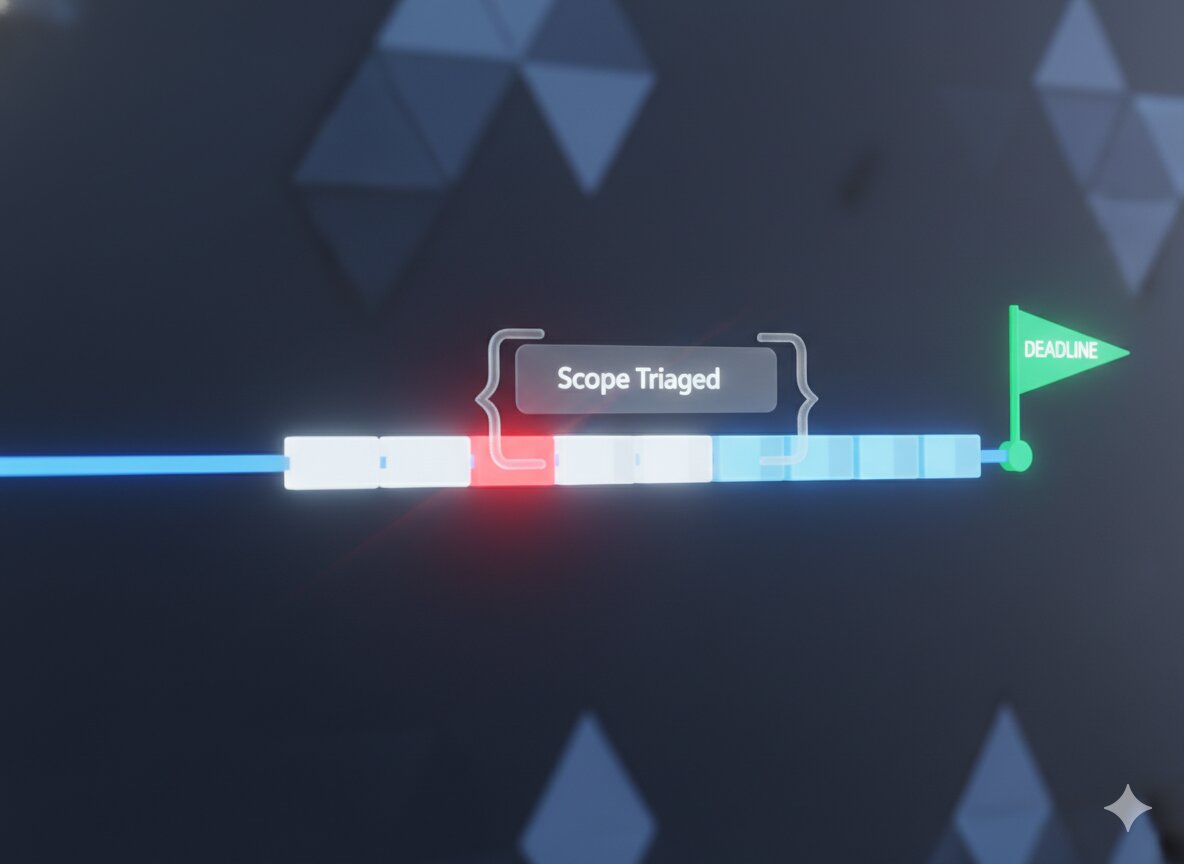
- The Soundbite: "I’ll review the 'Must-Haves.' Can we de-scope the 'nice-to-have' UI polish to hit the original date with the core functionality? I’d rather ship a 'Thin-but-Stable' version on time than a 'Full-but-Late' version that misses the market window."
3. A-lign Stakeholders (The "No Surprises" Rule)
Bad news doesn't get better with age.
- The Strategy: Communicate the Impact, Reason, and Options immediately.
- The Soundbite: "I’d brief the stakeholders today. I won't just tell them we're late; I’ll present two options: Option A is a delayed launch with full features. Option B is an on-time launch with reduced scope. I’ll provide a recommendation based on our business goals (e.g., hitting a specific marketing event)."
4. L-evel Resources & I-ncrease Buffer
How do we ensure the new date is actually the final date?
- The Strategy: Adjust the Velocity and add a Contingency Buffer.
- The Soundbite: "Once a new date is set, I’ll add a 20% 'Risk Buffer.' I’ll also look at 'Resource Leveling'—can we move a QA engineer from a lower-priority project to help stabilize this build? I’m looking to de-risk the path to the new finish line."
5. G-overnance & N-ext Steps (The Post-Mortem)
How do we stop this from happening again?
- The Strategy: Implement Early-Warning Indicators (e.g., stricter Sprint Burndown monitoring).
- The Soundbite: "After we ship, I’ll lead a 'Blameless Post-Mortem.' We’ll identify where our estimation process failed and implement 'Milestone Health Checks' earlier in the cycle for the next project."
The "Firefighter" (Reactive)The "REALIGN" Leader (Proactive)Hides the delay until the last minute.Communicates the risk the moment it’s identified.Asks the team to "Work Harder."Asks the team to "Work Smarter" via De-scoping.Promises a new date without a buffer.Defends a Realistic, Buffered Timeline.
Master the Art of Execution
Managing delays is the bread and butter of the TPM role and a critical "Execution" signal for PMs. If you can't lead a team through a crisis without losing their trust—or the stakeholders' confidence—you won't pass the "Leadership" bar at top tech firms.
The Kracd Prep Kits give you the exact "Crisis Communication" templates and "Risk Assessment" frameworks used by Senior Program Managers at Apple and Google.
- For PMs: Protect your roadmap and your reputation with the PM Prep Guide.
- For TPMs: Master the science of project recovery with the TPM Prep Kit.
FAQs
Q: Should I ever ask the team to work overtime?
A: Only as a last resort for a very short burst (2-3 days). Overtime leads to "Technical Debt" and "Bugs." In an interview, always prioritize Scope Reduction or Timeline Adjustment over "Burning out the team."
Q: What if a stakeholder refuses to accept a delay?
A: Use the "Iron Triangle." Explain that we can’t have the same scope in less time without sacrificing Quality (Bugs). Ask them: "Which is worse for the brand—a late launch or a broken launch that crashes for our customers?"
Q: How do I handle a "Hero" engineer who says they can fix it alone?
A: Verify and De-risk. While their enthusiasm is great, "Single Point of Failure" is a risk. I’d ask for a peer review of their plan to ensure the solution is sustainable and doesn't create future maintenance nightmares.






















.jpg)