Introduction
You are standing in front of a whiteboard in a high-stakes System Design interview for a Principal or Staff Engineering role. The interviewer writes down a deceptively simple prompt: "Design a globally distributed file storage system like Google Drive or Dropbox for 100 million active users."
Your pulse quickens. You jump straight to drawing databases and load balancers, blurting out: "We'll use Amazon S3 for storage and MySQL for metadata!"
Stop drawing immediately. Premature architecture design without defining scope, throughput constraints, and consistency trade-offs is a quick way to fail a system design loop. Senior interview panels do not expect a static diagram; they look for how you navigate trade-offs around durability, low-latency sync, chunking algorithms, and global consistency under heavy concurrent writes.
To structure your architecture from high-level constraints to detailed data flow, use the SCALE Framework.
The Core Framework: The SCALE Method
               [ System Prompt: Global File Storage ]
                                │
                                ▼
        ┌───────────────────────────────────────────────┐
        │  S-COPE & NUMERICAL CONSTRAINTS               │
        │  * Read/Write RPS, Storage, Bandwidth         │
        └───────────────────────┬───────────────────────┘
                                │
                                ▼
        ┌───────────────────────────────────────────────┐
        │  C-OMPONENT DESIGN & METADATA SEPARATION      │
        │  * Split Block Storage & Metadata Engine      │
        └───────────────────────┬───────────────────────┘
                                │
                                ▼
        ┌───────────────────────────────────────────────┐
        │  A-RCHITECTURE FOR FILE CHUNKING & SYNC       │
        │  * Fixed vs. Dynamic Chunking, Resume Sync    │
        └───────────────────────┬───────────────────────┘
                                │
                                ▼
        ┌───────────────────────────────────────────────┐
        │  L-OGICAL DATA MODEL & CONSISTENCY            │
        │  * NoSQL vs SQL, Strong vs Eventual           │
        └───────────────────────┬───────────────────────┘
                                │
                                ▼
        ┌───────────────────────────────────────────────┐
        │  E-XCEPTION HANDLING & RECOVERY SAFEGUARDS    │
        │  * Edge retries, conflict resolution, CDC     │
        └───────────────────────┬───────────────────────┘
                                │
                                ▼
              [ Production-Ready Architecture ]
Step 1: Scope & Numerical Constraints
Establish functional boundaries and calculate back-of-the-envelope capacity to drive your architectural choices.
- Bad Answer: "We'll build it to handle a lot of traffic and infinite files."
- Good Answer (Interview Soundbite):
"I’ll start by establishing capacity requirements. For 100M Daily Active Users uploading an average of 2 files per day at 1 MB each, we need to ingest 200TB of raw data daily. At an average upload rate, that requires sustaining ~2.3 GB/s ingress bandwidth and roughly 2,300 Write Requests Per Second. Our storage layer must support at least 73 Petabytes annually before replication."
Step 2: Component Design & Metadata Separation
Decouple control-plane metadata operations from data-plane file block streaming.
- Bad Answer: "We will store the files directly in a relational database blob column."
- Good Answer (Interview Soundbite):
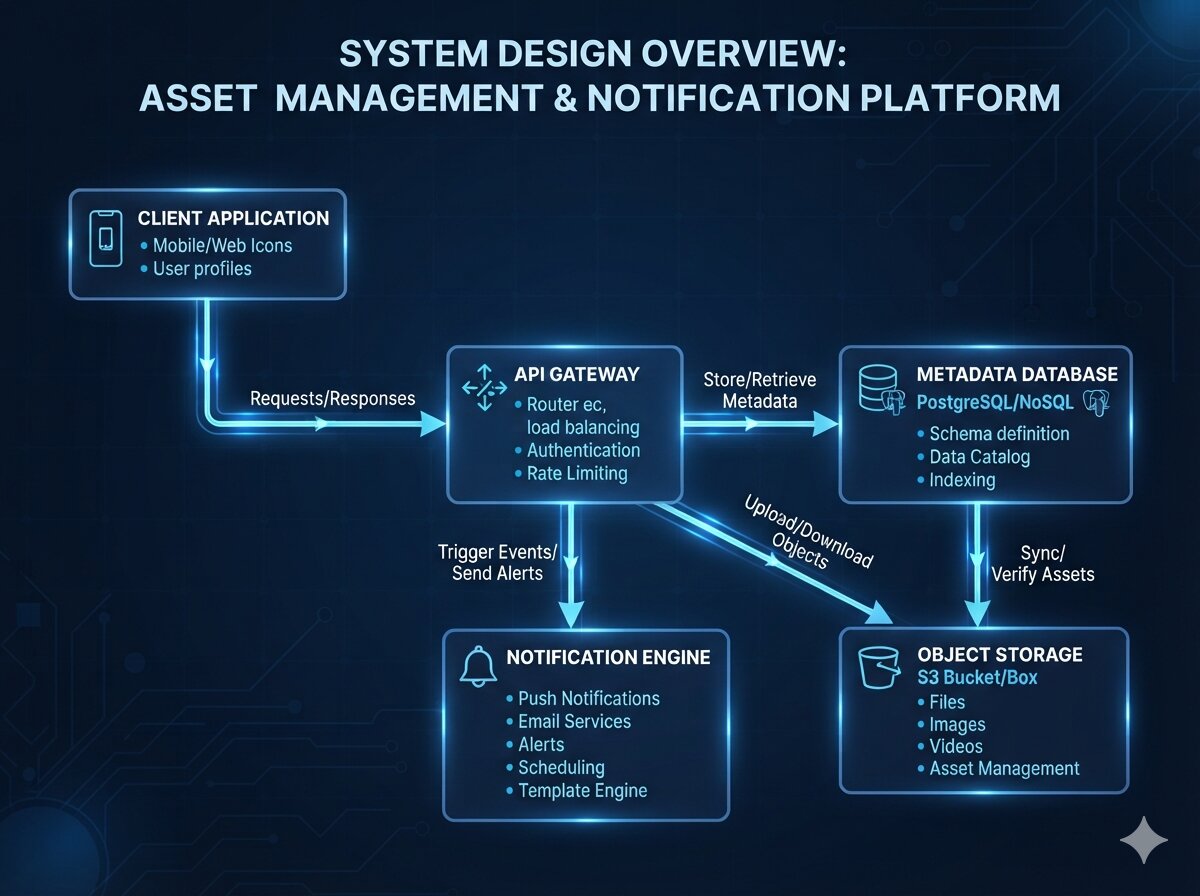
"To ensure scalability, I decouple the Control Plane from the Data Plane. Metadata operations (directory trees, access permissions, file versions) run through a high-throughput API gateway backed by a distributed key-value store. The actual file payloads bypass main API servers entirely, streaming directly to an S3-compatible object storage service via pre-signed URLs."
Step 3: Architecture for File Chunking & Sync
Optimize storage efficiency and upload reliability using content-defined chunking.
- Bad Answer: "Users upload the full file again every time they edit a single character."
- Good Answer (Interview Soundbite):
"To optimize bandwidth and storage, files are broken into 4MB immutable chunks on the client side using Rabin Fingerprinting for dynamic chunking. Each chunk is hashed (SHA-256) for deduplication. If a 1GB file changes by 1KB, only the modified chunk is re-uploaded, while existing chunks are referenced by their content hashes."
Step 4: Logical Data Model & Consistency
Define data access patterns, index strategies, and multi-region synchronization semantics.
- Bad Answer: "We will use eventual consistency everywhere to make it fast."
- Good Answer (Interview Soundbite):
"We enforce strong consistency for file metadata updates using a distributed consensus engine like Spanner or Cassandra with light transactions to prevent lost updates during concurrent edits. For the underlying storage blocks, object storage provides high durability (99.11 9s) via erasure coding across availability zones."
Step 5: Exception Handling & Recovery Safeguards
Build resilience against network partitions, partial chunk failures, and concurrent edit conflicts.
- Interview Soundbite:
"To handle concurrent modification conflicts, we employ Optimistic Concurrency Control (OCC) using version vectors. If two devices update a file simultaneously, the system creates a conflict copy rather than overwriting data. Failed chunk uploads use chunk-level resumable upload sessions tracked by a local database on the client."
Ace Your System Design Loops with Kracd
Navigating distributed systems trade-offs requires practicing real-world patterns under pressure. Elevate your technical interview performance with our comprehensive engineering resources:
- Master distributed systems, API gateway design, and data modeling with the System Design Prep Guide.
- Master cloud architecture, reliability engineering, and technical roadmap execution with the TPM Prep Kit.
Frequently Asked Questions (FAQs)
1. How do you handle file deduplication globally vs. locally?
Global deduplication checks chunk SHA-256 hashes against a global metadata index before initiating an upload. If the hash exists, the system simply creates a new metadata pointer without re-uploading the physical bytes.
2. What is the difference between fixed-size and dynamic chunking?
Fixed-size chunking splits files every $N$ megabytes; however, inserting a byte at the beginning shifts all boundary offsets, breaking deduplication. Dynamic chunking uses a rolling hash (like Rabin Fingerprinting) to set boundaries based on content patterns, keeping unchanged chunks intact.
3. How do client applications stay synced across multiple devices in real time?
Clients establish long-polling connections or WebSockets with a Notification Service. When a metadata commit occurs, the notification service pushes an invalidation signal to all registered devices belonging to that user, triggering a background delta sync.























.jpg)