Introduction
You are in the middle of a roadmap interview. The interviewer throws a grenade:
"The CEO wants Feature A. The Sales team promises Feature B will close a huge deal. The Engineering team says if we don't build Feature C (tech debt), the system will crash. You only have resources for one. What do you do?"
This is the Prioritization question.
Most candidates fail because they try to please everyone. They say, "I'd try to squeeze in a little bit of everything," or "I'd listen to the CEO."
Wrong.
Great PMs and TPMs know that strategy is what you don't do. Interviewers want to see a structured, mathematical approach to decision-making, not a popularity contest.
In this post, we’ll break down the top frameworks (RICE, MoSCoW, Kano) and teach you how to answer this question like a Lead PM.
The Core Principle: ROI (Return on Investment)
Prioritization is simply calculating the ROI of Engineering Effort.
- Numerator: Value (Revenue, User Growth, Satisfaction).
- Denominator: Cost (Time, Engineering Weeks, Complexity).
Your job is to maximize the Numerator and minimize the Denominator.
The 3 Frameworks You Must Know
Don't just pick one at random. Choose the framework that fits the context of the interview question.
1. RICE Score (The "Growth" Framework)
Best for: Growth teams, existing products, and comparing disparate features.
- Reach: How many users will this touch? (e.g., 500 users vs. 50,000).
- Impact: How much will it move the needle? (3 = Massive, 0.25 = Minimal).
- Confidence: How sure are we? (100% = We have data, 50% = It's a hunch).
- Effort: Person-months to build.
- Formula: $(R \times I \times C) / E$
The Interview Soundbite: "Since our goal is to maximize user adoption, I would use the RICE framework. Even though the CEO's idea has high Impact, the Effort is massive, giving it a low RICE score compared to the 'Quick Win' feature."
2. MoSCoW Method (The "Deadline" Framework)
Best for: TPMs, Launch constraints, and MVP definitions.
- Must Have: If we don't ship this, the product doesn't work (e.g., "Login").
- Should Have: Important, but can wait a week (e.g., "Password Reset").
- Could Have: Nice to have if we have time (e.g., "Dark Mode").
- Won't Have: Out of scope for now.
The Interview Soundbite: "Since we are launching in 4 weeks, I would use MoSCoW to protect the launch date. I’d classify the Sales request as a 'Should Have'—we want it, but it's not a launch blocker. The Tech Debt is a 'Must Have' because reliability is non-negotiable."
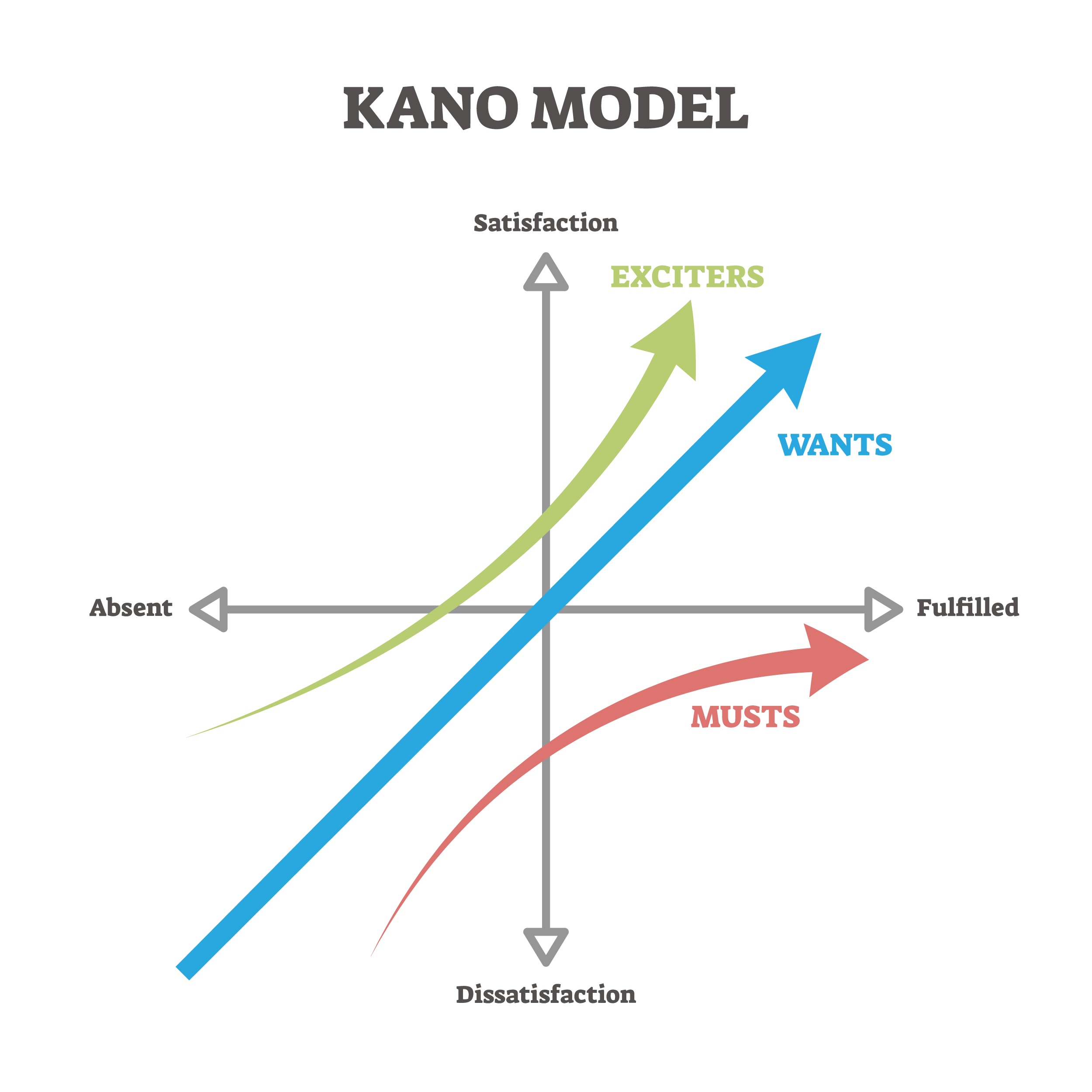
3. The Kano Model (The "Delight" Framework)
Best for: New products and competitive strategy.
Shutterstock
Explore
- Basic Needs: If you miss these, users leave. If you nail them, nobody cares (e.g., "Car brakes").
- Performance Needs: The more, the better (e.g., "Car mileage").
- Delighters: Unexpected wow factors (e.g., "Free heated seats").
The Interview Soundbite: "We can't just build 'Basic Needs' or we'll look like a utility. I would prioritize one 'Delighter' to differentiate us from the competition, while maintaining just enough 'Basics' to be functional."
How to Answer the "CEO vs. Sales vs. Eng" Question
Here is the winning script:
- Clarify the Goal: "What is our North Star metric right now? Is it Revenue (Sales), Retention (Tech Debt), or Strategic Vision (CEO)?"
- Apply a Framework: "Assuming our current goal is Retention, I would prioritize the Tech Debt (Feature C). Without a stable platform, Feature A and B are useless because users will churn."
- Manage Stakeholders: "I would then go to the Sales team and the CEO, show them the data/trade-offs, and explain that by fixing the Tech Debt now, we can build their features 2x faster next quarter."
Stop Guessing. Start Calculating.
Prioritization is a science. If you can't justify your roadmap with logic, you won't get the job.
Our Mastering Product Management Guide and TPM Prep Kit include:
- Prioritization Spreadsheets: Excel templates for RICE and Weighted Scoring.
- Stakeholder Scripts: Exactly what to say to say "No" to a CEO without getting fired.
- The "Urgency vs. Importance" Matrix: How to manage your own time as a PM/TPM.
👉 Get the PM Prep Guide or Get the TPM Prep Kit today.
FAQs
Q1: Can I mix frameworks?
Yes! A senior answer might be: "I use MoSCoW to determine the MVP scope, but within the 'Should Haves,' I use RICE to rank them." This shows incredible depth.
Q2: What if the data is missing (Confidence is low)?
This is a trap! If Confidence is low, your prioritization is a guess. The correct answer is: "I would prioritize a 'Spike' (Research Task) to get the data first, raising our Confidence score before committing to full development."
Q3: Does this apply to TPMs?
Absolutely. TPMs constantly negotiate scope. Using MoSCoW is the TPM's primary weapon to cut scope when a project is running late.



















.jpg)